
Zero Tax Up to ₹12 Lakh: What Self-Employed Sellers Actually Need to Know
Your salaried friend called you in February to celebrate. "No tax up to ₹12.75 lakh!" Great news. But if you run a business — sell on Amazon, operate a D2C brand, do freelance work, or run any kind of proprietorship — your situation is different. The ₹12 lakh zero-tax threshold is real. It applies to you. But the fine print that salaried employees don't have to worry about is exactly where most self-employed sellers trip up — and this July, when you're actually filing your ITR for FY 2025-26, is when that fine print catches up with you.
Here's the actual picture, with numbers, for the return you're filing right now.
What Changed in Budget 2025 — The Short Version
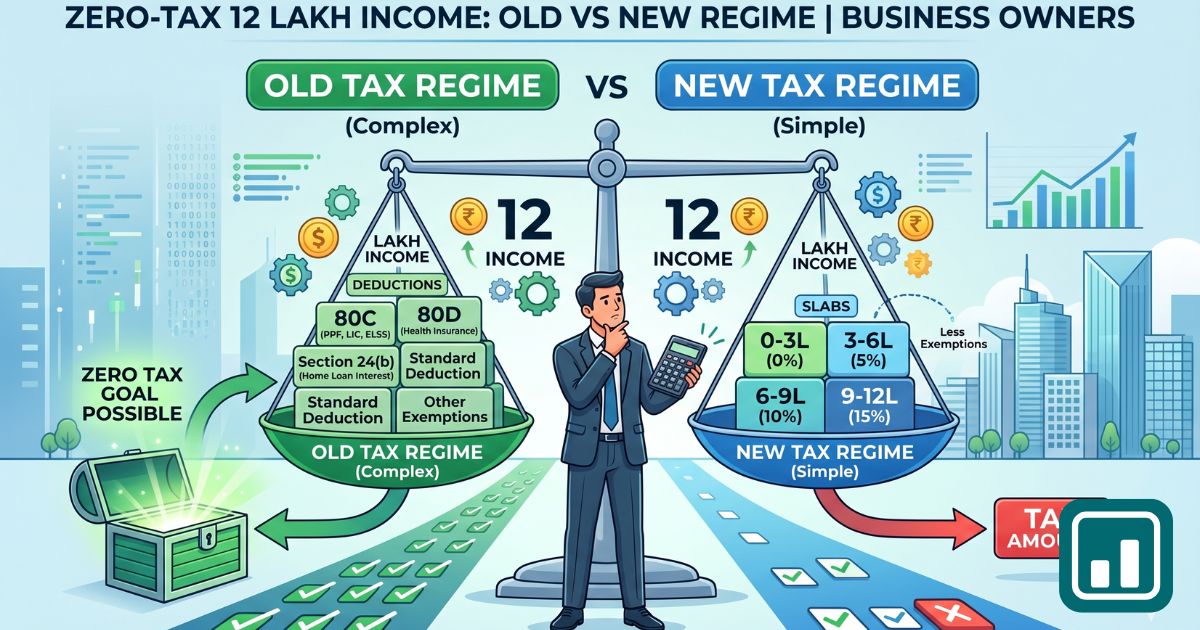
FM Nirmala Sitharaman announced zero income tax for annual income up to ₹12 lakh under the new tax regime, effective FY 2025-26. The mechanism is a Section 87A rebate of ₹60,000 — which completely offsets the tax computed on income up to ₹12 lakh under the new slabs. The new regime is also now the default — you're automatically in it unless you actively opt out.
The new tax regime slabs, unchanged since Budget 2025 and still in effect for FY 2026-27, look like this:
| Income Slab | New Regime Tax Rate |
|---|---|
| Up to ₹4 lakh | Nil |
| ₹4 lakh – ₹8 lakh | 5% |
| ₹8 lakh – ₹12 lakh | 10% |
| ₹12 lakh – ₹16 lakh | 15% |
| ₹16 lakh – ₹20 lakh | 20% |
| ₹20 lakh – ₹24 lakh | 25% |
| Above ₹24 lakh | 30% |
At ₹12 lakh, the computed tax is ₹60,000. The Section 87A rebate is ₹60,000. Net tax payable: zero. taxguru
The Part That Changes If You Run a Business
A salaried employee earning ₹12.75 lakh pays zero tax under the new regime. That extra ₹75,000 comes from the standard deduction — a flat deduction available to salaried individuals and pensioners.
If you're a sole proprietor, freelancer, e-commerce seller filing as an individual, or D2C brand owner, you don't get the standard deduction under the new regime. Your zero-tax ceiling is ₹12 lakh flat, not ₹12.75 lakh. A small difference on paper, but ₹75,000 of income taxed at 15% is ₹11,250 — real money.
More importantly: the Section 87A rebate under the new regime doesn't apply to special rate income — primarily capital gains. If you sold mutual funds, stocks, or property this year alongside your business income, the capital gains portion is taxed at its own rate regardless of your total income. Your ₹12 lakh business profit might be zero-tax; a ₹2 lakh LTCG on top of it is not. pib.gov
And one more hard stop: the rebate is only available to resident individuals. HUFs, partnership firms, LLPs, and private limited companies get no benefit from Section 87A — not even the ₹12,500 old-regime version. If your business is structured as an LLP or Pvt Ltd, this rebate doesn't exist for you at the entity level.
The Presumptive Taxation Wrinkle Most Sellers Miss
If you file under Section 44AD (presumptive taxation) — the default for most e-commerce sellers with turnover under ₹2 crore (₹3 crore if 95%+ digital receipts) — the regime choice interacts with your ITR form in a way that's easy to get wrong.
Presumptive taxpayers filing ITR-4 can switch between the old and new regime every year simply by selecting it on the form — no separate opt-out filing needed, unlike individuals with regular business income who must submit Form 10-IEA to opt for the old regime. But if you ever opt out of presumptive taxation (to claim actual expenses instead of the flat 6-8% profit), you lose the right to re-enter Section 44AD for 5 assessment years, and from then on you're locked into the stricter opt-in/opt-out rules that apply to regular business income under ITR-3.
Practically: if you're comfortably under ₹12 lakh declared profit and staying in presumptive taxation, the new regime and zero-87A-rebate math above applies cleanly, year to year, with no extra paperwork. The complexity shows up the moment you cross the presumptive turnover limit or choose to opt out — check our ITR-3 vs ITR-4 quiz if you're unsure which form you're filing this year.
Old Regime vs. New Regime: When Each One Wins
The old regime didn't change. It still has higher headline rates but lets you claim deductions that reduce your taxable income — 80C investments, health insurance premiums, home loan interest, HRA, and more.
| Old Regime | New Regime | |
|---|---|---|
| Basic exemption | ₹2.5 lakh | ₹4 lakh |
| Standard deduction | ₹50,000 (salaried only) | ₹75,000 (salaried only) |
| Section 87A rebate | ₹12,500 (up to ₹5L income) | ₹60,000 (up to ₹12L income) |
| 80C deduction (₹1.5L) | ✅ Available | ❌ Not available |
| 80D (health insurance) | ✅ Available | ❌ Not available |
| Home loan interest (24b) | ✅ Available | ❌ Not available |
| HRA exemption | ✅ Available | ❌ Not available |
| Default regime? | No (must opt in) | Yes |
The new regime wins if your deductions are low. The old regime wins if your deductions are high enough to push your taxable income below what the new slabs would compute. The break-even point:
Rajan runs a ₹15 lakh/year D2C brand as a sole proprietor. Under the new regime, he pays tax on ₹15 lakh at the new slabs — computed tax is approximately ₹1,42,500 (₹60,000 + ₹75,000 at 15%). Under the old regime, he claims: ₹1.5 lakh in PPF and ELSS (80C) + ₹25,000 health insurance (80D) + ₹1.5 lakh home loan interest (24b). That's ₹3.25 lakh in deductions. Taxable income drops to ₹11.75 lakh → tax under old slabs is approximately ₹1,62,500. New regime wins by ₹20,000.
But add a housing loan interest claim of ₹2 lakh instead of ₹1.5 lakh, and the math flips. The crossover isn't a fixed income number — it depends entirely on which deductions you actually use.
The ₹12–15 Lakh Zone: The Most Important Bracket for Sellers
If your business profit lands in the ₹12–15 lakh range, this is where the regime choice matters most — and where most sellers are currently making the decision wrong because they haven't done the calculation.
At ₹12 lakh, the answer is easy: new regime, zero tax, done.
At ₹12.01 lakh, something unexpected happens. The Section 87A rebate disappears entirely — it's a cliff, not a taper. At ₹12,00,001, the rebate is zero and you're taxed on the full ₹12,00,001 at the applicable slab. The tax jumps from ₹0 to approximately ₹60,000 on a single rupee of additional income. This is called marginal relief — if you're in this zone, work with your CA to understand the implications before invoicing that final order of the year.
For income between ₹12 lakh and ₹15 lakh: run the numbers. The new regime is often still better, but it's not guaranteed. Ask your CA for a computation under both regimes before you file.
Three Practical Scenarios for Business Owners
Scenario 1 — E-commerce seller, ₹10 lakh annual profit, no significant investments: New regime wins decisively. Zero tax, no paperwork on deductions, simpler ITR. You're done in an hour on ClearTax.
Scenario 2 — D2C founder, ₹18 lakh profit, pays ₹2.4L home loan interest + ₹1.5L 80C + ₹50K 80D: Total deductions = ₹4.4 lakh. Old regime taxable income = ₹13.6 lakh → tax ≈ ₹1,72,000. New regime tax on ₹18 lakh ≈ ₹2,10,000. Old regime saves ₹38,000. Check your numbers.
Scenario 3 — Freelancer, ₹8 lakh income, invests ₹1.5L in ELSS: Old regime taxable income = ₹6.5 lakh → tax = ₹45,000. New regime tax on ₹8 lakh = ₹20,000, rebate applicable = zero (income above ₹7L but below ₹12L — rebate covers it fully). New regime wins with zero tax. The ELSS investment can continue — it doesn't have to be for tax purposes.
What to Do Before You File This July
-
Ask your CA for a dual computation. One number under old regime, one under new, before you submit your ITR. If the difference is under ₹10,000, the simplicity of the new regime is worth the switch anyway.
-
Check your business structure. If you're filing as an individual/sole proprietor, the ₹12L zero-tax applies. If you're an LLP or Pvt Ltd, it doesn't — plan around your entity's actual tax rates.
-
Reconcile your AIS before declaring income. Your AIS shows GST turnover reported by GSTN alongside TDS/TCS entries — check it matches what you're about to declare. See our guide to reading your AIS before you file.
-
Switch regime correctly. If you have regular business income (not presumptive) and want to opt for the old regime, you must file Form 10-IEA before or with your ITR. Once you've moved to the new regime under this route, restrictions apply on switching back — presumptive (44AD/44ADA) filers under ITR-4 don't have this restriction and can pick either regime each year on the form itself.
-
Check your advance tax position. If your total tax liability for the year was above ₹10,000, you should already have paid advance tax in quarterly instalments. With the revised slabs, many sellers who were paying based on old-regime estimates may have overpaid — reconcile this before you file so any refund is claimed correctly. Use the Advance Tax Calculator to check.
To understand how your GSTN-linked income aligns with your ITR income — a common discrepancy for e-commerce sellers — check the GST guide for e-commerce sellers. If you're behind on GST filings, get those cleared first at the GST return filing page — a mismatch between your ITR income and your GSTR-1 turnover is a red flag in automated scrutiny. If you haven't decided which ITR form applies to you, take the ITR-3 vs ITR-4 quiz first.
The ₹12 lakh zero-tax headline is real. For most self-employed sellers with modest deductions and sub-₹12 lakh profits, the new regime is a genuine win. What it isn't is a blanket instruction for every business owner. Five minutes with your CA and the two numbers — old regime vs new — is the only analysis that matters before you file.
Calculate your own tax: New vs Old Tax Regime Calculator · Income Tax Slabs FY 2026-27 · Advance Tax Calculator · ITR Filing Guide for E-commerce Sellers · Which ITR Form Should I File?
Not sure which tax regime saves you more?
Compare the old and new regime for your business income, then check your advance tax dues so nothing slips past a deadline.
Newsletter
GST updates & guides, free.
Join sellers who get our weekly digest on GST compliance, e-commerce rules, and finance tips — no spam.
No spam. Unsubscribe anytime.